
How to spot what’s working, what’s holding your studio back, and what to fix first.
Pilates is having a moment. New studios are opening, Reformer concepts are everywhere, and more people than ever are discovering the method. On the surface, this should be an exciting time to own a Pilates studio.
And yet, when I talk to independent studio owners, I often hear the same frustration: growth and sometimes even sustainable operation feels hard.
The instinct is usually to look at marketing first. Maybe the website needs work. Maybe social media needs to be more consistent. Maybe the studio needs better software, a new intro offer, or a different schedule.
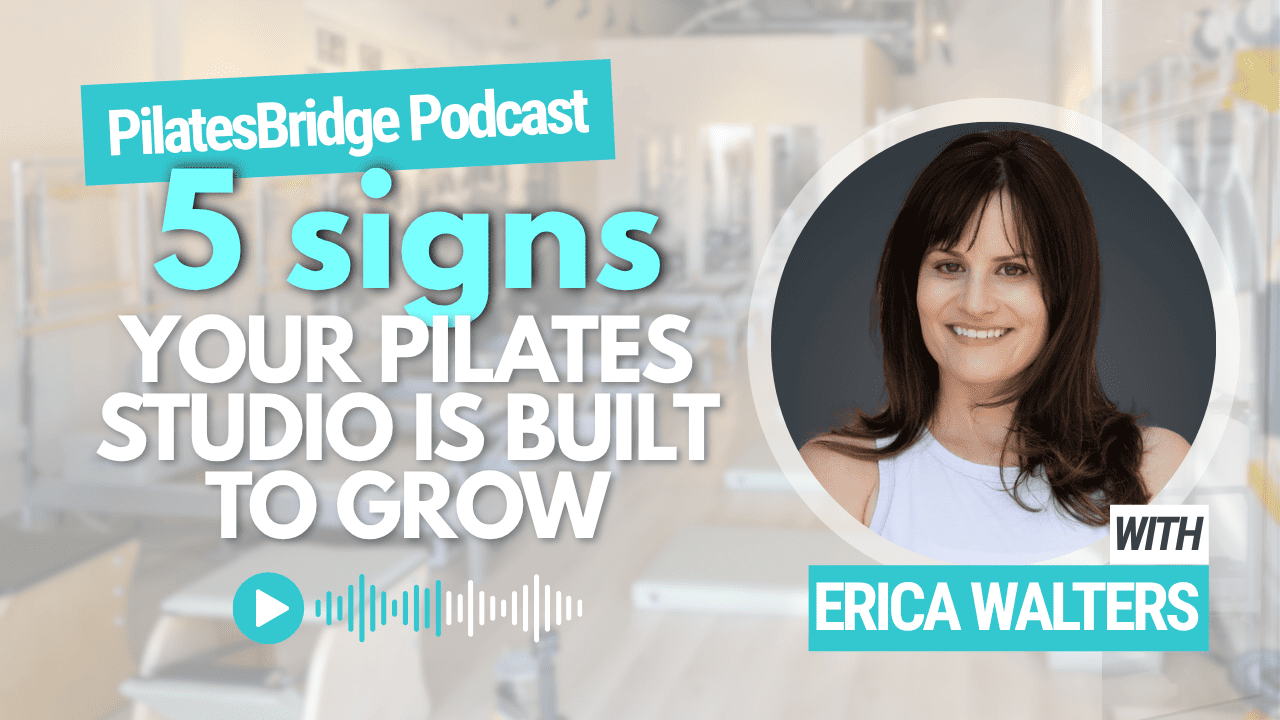
But during my recent PilatesBridge conversation with Erica Walters, we kept coming back to something more fundamental: before trying to fix marketing, studio owners need to look at the clarity of the business itself.
Erica has seen this from several angles. She started with a home-based studio, expanded into commercial locations, became a teacher training host studio, sold one of her studios, and is now opening another location in Scottsdale, AZ. What she has developed over the years is a strong understanding of branding and systems – and how those two things help boutique studios stand out in a crowded market.
In a recent PilatesBridge Live Show, I spoke with Erica Walters, a longtime Pilates and GYROTONIC® teacher and studio owner who has built, expanded, and sold studio locations over the years. We talked about what really helps a boutique Pilates studio grow, why brand clarity matters more than most owners realize, and how strong systems can support everything from client retention to teacher consistency.
🎙 Guest Educator: Erica Walters is a classical Pilates and GYROTONIC® teacher with more than 20 years of experience and over a decade as a studio owner. She is a Master Instructor and LIT for Real Pilates® of New York City, co-owns Pilates Fit Studio in Louisville, and is opening Real Pilates® Scottsdale in winter 2026. Erica is also the creator of The Better Back® and Studio Stack Pro™, a branding and systems course for boutique Pilates studio owners.
Resources mentioned:
- Studio Stack Pro
Use code BRANDING50 for a 15% discount* at checkout. Valid through Oct 15th, 2026.
Studio Stack PRO™ is everything you need to build a studio that stands out in a saturated market with a clear onboarding process that drives conversions, consistent cash flow, and systems that support long-term client retention.
Meet Erica Walters

Erica Walters has taught classical Pilates and GYROTONIC® for more than twenty years and has owned studios for twelve. She started Pilates Fit Studio in her home in 2014, grew it into two Kentucky locations, expanded the original twice, and built it into a studio someone wanted to buy and carry forward. She sold that location in 2026 and co-owns the Indian Hills location in Louisville with Andrea Camiolo. She opened Real Pilates® Scottsdale in winter 2026. She is a Master Instructor and LIT for Real Pilates® of New York City, trained under Alycea Ungaro in New York. Additionally, she completed advanced training at The Pilates Center in Boulder. She created The Better Back®, a spine and bone health program for certified teachers, and Studio Stack Pro™, a branding and systems course for boutique studio owners that grew out of coaching requests she kept getting from other owners.
When every Pilates studio starts to sound the same
Spend a few minutes browsing Pilates studio websites, and you will start to notice the same phrases over and over again: feel stronger, move better, everyone is welcome, small classes, personal attention.
There is nothing wrong with those statements. The problem is that when every studio says the same thing, they stop helping a prospective client understand why one studio is different from another.
Erica pointed out that when messaging becomes too general, clients are left with fewer meaningful ways to compare studios. Price and convenience become more important because the value of the experience has not been made clear enough.
That is where a boutique studio can get into trouble.
An independent studio offering highly trained teachers, thoughtful progression, individualized programming, and a more personal experience is not offering the same product as a high-volume fitness concept. But if the website makes those businesses look interchangeable, the client has no reason to understand the difference.
Erica’s own Pilates studio in Louisville, KY is a good example of how specificity changes that conversation. Instead of simply saying Pilates is for everyone, her websites highlight programs such as active aging, osteoporosis, GYROTONIC®, and progressive classical Pilates. A potential client who is active, getting older, managing bone-density concerns, or looking for a more structured approach can immediately see how the studio may fit her needs.
And if someone is looking for a completely different kind of experience, that person may decide the studio is not for them. Erica does not see that as a loss. Clear positioning helps the right clients recognize themselves while allowing the wrong ones to self-select out.
Your brand has to show up beyond the website
Erica and I have been working together for over 10 years and our views on branding align so much that we even co-hosted a workshop on it. Branding is not just as a logo, color palette, or Instagram feed. Brand is the consistency of the experience across every touchpoint.
That includes what someone sees on the website, how easy it is to book, what happens during the first session, how the client moves into ongoing programming, and whether the experience remains consistent when different teachers are involved.
This is where marketing and operations become closely connected.
A polished Pilates studio website and a strategic marketing campaign can bring clients into the studio, but if the in-studio experience feels disorganized or inconsistent, the brand promise starts to fall apart. As a result, intro offers do not turn into loyal studio members and the studio suffers struggles to be profitable.
Erica said during the session that software cannot fix your systems. That is especially relevant right now, when studio owners have access to more platforms and tools than ever. Technology works best when the client journey is already clear and the studio knows exactly what it wants the software to support.
The five signs of a studio brand that is working
During the Live Show, Erica shared a simple five-part checkup that studio owners can use to evaluate where their business is strong and where it may be leaking.
1. Your clients know what you stand for
A useful test is to ask several clients what makes your studio different from another Pilates studio nearby.
If their answers are similar, that is a good sign that your positioning is clear. If every client gives a completely different response – or describes your studio in a way that could apply to almost any business – you may need to sharpen the message.
Erica recommends making this very practical. Ask five clients the same question and compare their answers. Then review your website and remove language that could belong to any studio.
The point is not to create a clever tagline. It is to make sure that what you say online matches what clients actually experience.
2. Your instructors teach consistently
Consistency does not mean every teacher should sound the same.
Teachers should have their own personalities and teaching styles, but clients should still feel that they are part of one studio rather than several unrelated practices operating under the same roof.
That kind of consistency comes from shared standards, hiring criteria, onboarding, documented expectations, and client notes that are actually used. Erica also talked about how important it is to hire teachers who are willing to work within the studio’s values and programming structure, even if they come from different training backgrounds.
This becomes especially important for studio owners who are trying to step back from teaching or hand clients over to other instructors. If clients only trust one person in the studio, the business remains dependent on that teacher.
3. Your programming has purpose
Another area Erica emphasized was progression.
Clients should have some sense of where they are going rather than simply attending session after session with no clear path. That does not mean every studio needs a rigid level system, but it does mean there should be a reason behind the programming.
What does a beginner need to learn before moving forward? What changes as a client progresses? What keeps an advanced client engaged after several years?
Erica explained that programming should feel intentional enough that clients understand what comes next. When there is no visible progression, there is less reason for the client to stay engaged long term.
I think this is particularly important in Pilates because the work is so rich. A client can stay with the method for decades, but only if the studio continues to help that person understand what they are learning, how they are progressing, and why the work is still relevant.
4. Your community is engaged
Retention is not only about results. It is also about belonging.
Erica shared stories of clients who have trained together for years and built friendships outside the studio. Some go to lunch together, help each other with appointments, and have become part of one another’s lives. That kind of connection cannot be created with a discount or promotional offer. It develops because clients feel known and seen.
Studio owners sometimes think they need more events to build community, but Erica made an important distinction. Events can help, but they do not create belonging on their own.
Community grows more naturally when clients share a clear path, experience consistent care, and feel connected to what the studio stands for.
5. You are known for something specific
The last sign is probably the hardest because it requires making choices.
What do you want people in your community to associate with your studio? Maybe it is osteoporosis programming, active aging, classical Pilates, neurological conditions, teacher training, post-rehab work, or something else entirely.
Whatever it is, the studio needs to be willing to communicate it clearly and consistently.
Erica also pointed out that being known for something usually means being willing to say no to other things. A studio cannot be everything to everyone and still expect its positioning to feel strong.
That does not make the business smaller. In many cases, specificity is what helps the business become more visible to the people who are already looking for exactly that kind of service.
Where should you start?
At the end of the five-point checkup, Erica asked viewers to rate themselves from one to five in each category: client clarity, teacher consistency, purposeful programming, community engagement, and being known for something specific.
Then she gave very simple advice: look at the lowest score and start there.
I like this approach because studio owners are constantly being told to fix everything at once. Improve the website. Post more. Build a referral program. Update the schedule. Train the staff. Add a CRM. Create better offers. It becomes overwhelming quickly.
The checkup gives you a way to narrow the problem down. If your teachers are inconsistent, work on shared standards. If clients do not understand what makes the studio different, work on positioning. If programming feels random, map out the client journey. If community is weak, look for ways to help clients feel more connected and recognized.
These areas are not isolated, either. Weak positioning can bring in the wrong clients. Weak systems can hurt retention. Poor teacher consistency can damage trust. When the foundation is stronger, marketing becomes easier because the business is already giving people something clear and consistent to respond to.
Growth does not have to mean becoming bigger
One thing I appreciated throughout our conversation was that Erica did not define success only in terms of expansion.
She has opened multiple locations, but she also talked about the importance of understanding capacity, margins, teacher retention, client retention, and what a healthy studio looks like for the individual owner. A studio with two teachers who are at capacity and profitable can be just as healthy as a much larger operation.
When one viewer asked how long it took Erica to open her second commercial location, she explained that it happened about seven years after the first. By then, she had W-2 employees, memberships, consistent revenue, trained teachers, and systems that could support the expansion.
For some studio owners, growth may mean opening another location. For others, it may mean having a full schedule, a strong team, loyal clients, reliable revenue, and enough space to enjoy life outside the studio.
What stayed with me most after this conversation was how often we returned to clarity and systems. Studio owners sometimes look for the next marketing tactic when the real opportunity is closer to home: getting clearer about who the studio serves, what it does well, how clients move through the experience, and what the team is expected to deliver.
Once those pieces are in place, growth becomes much more sustainable because the business is not simply attracting more people. It is creating an experience that the right people can understand, trust, and want to stay with.
Full Live Show Transcript
Anastasiya Goers (00:03.476)
Is your Pilates studio built to grow, or is it or are unclear messaging, inconsistent teaching, and weak points of difference quietly holding it back? In this session, I’m talking to Erica Walters, and we will be breaking down five signs of a strong Pilates studio. Erica is a classical Pilates teacher and a GYROTONIC teacher. She owned, she started by opening her home-based Pilates studio. I don’t know if we’ll talk a little bit how many years ago and now she opened two retail locations and now she’s opening a third one. She sold studios; she’s opened new ones, so she really knows what it takes to build a boutique, private, personalized experience for her clients. So welcome Erica to our show today, and before we get started with the questions and everything that you have to share with us.
Please tell us a little bit about yourself and your story.
Erica Walters (01:06.415)
I am Erica. And as Anastasia said, I did recently just sell a very large studio of mine. I still have one in Louisville and I’m opening a third in Scottsdale, but I guess now it would be just a second location because I don’t have the other. And I would say that I’m not a coach, I don’t have any programming that you know guides you into how you’re going to make more money or do certain things. But what I do have is branding and systems down. And I do have a course on that. But it is how you’re going to stand out in a saturated market without paying for ads and without being general. You’re going to get the right clients to self-select in and the wrong clients to self-select out and so I think that the boutique studio can stand out among the franchises and all the things that are happening around them. And I want to share that because I believe in the boutique studio. So that’s a little bit about what I want to do today and help people and I want to see more small studios thrive.
Anastasiya Goers (02:22.251)
And I know like that this is something that I hear a lot from my clients are in in our Pilates community that it’s a struggle. it seems like Pilates is really booming, everybody’s talking about Pilates, something, but at the same time it’s becoming more and more difficult. I feel for the small those b real boutique studios to stand out. I would not necessarily say compete because we’re not competing, this are different types of services and we’re serving different types of clients, but still standing out and attracting, there’s definitely value in what the boutique plates offers. It there’s definitely the demographic and clientele that’s searching for that. but the difficult part a lot of times is really separating and showing people that you’re different from whatever else is out there.
Erica Walters (03:17.894)
I think that is you got the Pilates boom, so to say, but who are these pop-up franchises, new trends attracting? And so what I was doing marketing to search out in my Indian Hills location in Lobile and in my Scottsdale location, who was surrounding me? Who was directly across the street from me and what did they offer? And their home pages, a lot of them burn, you know, feel the muscle burn, get the best workout of your life, get the Pilates lifestyle. And I’m like, okay, well, I don’t do that. And even, you know, classical GYROTONIC and across the street, there was a contemporary studio where I would say that might be my most competition with having a teacher training for that type of program. But again, what she offered was very general. And so in an area I can take Scottsdale or Indian pills and Lowhole, these are two very similar cities is my Indian hills is surrounded by franchises. But on my websites, they’re talking about our programming. So, you know, we have Elevate or Real Pilates, whatever you want to call it. I’m a Real Pilates studio, so I do use that term. and that’s your intermediate, beginner, all those. Then you have what we call Pilates for Active Adults, our wisdom program. Those are your clients who are living their second active life. They have second homes, they’re playing pickleball, they’re doing all the things.
We have our osteoporosis programming and then we have our gyrotonic. So the minute somebody comes and types in Pilates and they’re looking, the person who’s looking for the group where they want to burn and be able to record themselves and get that $50 a month to join those group classes is going to self-select right off my page. And the person I’m looking for is their mom or grandma, is going to come and say, I have osteoporosis or I am still wanting to hike and I am on the course and I am playing pickleball. This fits me. So you need to be able to say that. It’s nice to say we’re fitness for everybody. Come one, come all. It’s so kind, but how does the right person find you if they can’t see themselves there? And so with the Pilates boom, you just need to know what you offer and say it. So that’s my answer.
Erica Walters (05:42.738)
Specifically to that, who are you attracting?
Anastasiya Goers (05:46.69)
Yeah, I think it it’s great. It’s yeah, you can’t you can’t market to everybody. You can’t reach everybody and not everybody can afford, especially a boutique experience. That’s why they’re different levels.
Erica Walters (05:58.8)
You know, I yeah, I think there’s like an FSA Pilates addiction. I drove by by my hairdresser and I was like, there’s that place. Cool. And I drove by, but I’m realizing the pricing that they offer and this Pilates lifestyle is the younger crowd in, you know, the aloe and the cute Beori, and they’re wearing their hats and they can record themselves and they’re putting it out there.
And those influencers are reaching other influencers and they have their marketing. But the next place that opens up, that’s going to be the next trend, those people are going there. Where you’re looking for longevity in specific programming, the person who is looking to have longevity in their fitness, their second act of life, all those things isn’t trend popping. So it’s easy for me to say, I’m not worried about them. My clients are not leaving me for them. But if I’m trying to compete with them, my clients are leaving for them.
Anastasiya Goers (07:03.777)
That’s good. so why do you think like that small boutique studios are being pushed to measure success by their own standards right now? I feel like it’s a lot of times. I don’t know, there are all the supports about what the healthy studio looks like, you know, business-wise, a lot of times. And a lot of times the boutique studios might not really fit within that range. I mean I know one of them was in like the number of classes people visit in a studio there are others the number of members and all of those types of things that usually a lot of the studios they think this this must be the sign that my studio is doing good. Do you think that the same kind of signs that work for the general fitness large group studios apply to boutique studios.
Erica Walters (08:03.044)
Well, one, yes, you do need to know your numbers, your capacity, your profit margins, all of that. But put that aside. because you have to know that. And if you don’t know how to do it, like me, I’ll hire a bookkeeper to help me. is you look at your teacher retention. And I yes, client retention is so important, but what’s your teacher retention? Do you retain teachers long term? I’ve had some teachers with me for over 12 years, they’re not going anywhere. How full are their books? Are they at capacity? Am I at capacity in my teaching? Who is, you know, where is that and how am I growing? So yes, you have your numbers, but for me, when I’m looking at it, I’m looking at where are my teachers? and how full are they? So that’s gonna fall on the capacity section. How many I we I call them active members versus my package clients, but one studio has fifty nine active members. That means fifty-nine people are on membership and the average is six hundred dollars a month from those fifty nine. No, obviously it goes up and down in different directions. But that tells me my numbers of what’s coming in and what’s going out. But I have to look I do have to look at the numbers. And numbers I always say this the math has to math. So if I have two teachers and we’re all at capacity, but my profit margin is still at its 30%, then I would say I’m still doing just as well as my studio in Indian Hills that has 14 teachers. Because the math has math. I don’t know if I answered that, but that’s the only way I can say you do have to learn the math, learn the reports. And today’s software companies, their reporting system is phenomenal. So even if you don’t know how to do that it’s still there.
Anastasiya Goers (10:03.399)
Let me ask you that real fast since we’re talking about the numbers and I know I talked to the other experts and studio owners before about the numbers. In your opinion, what are the most critical numbers that you look at as a studio owner on a monthly basis?
Erica Walters (10:23.996)
To look at client retention and teacher retention. And so who and that goes into revenue categories, but how is my are are my teachers, and we have a three-step process, are they able or are we churning or do they have longstanding clients? And so those matter to me. So if I’ve got a teacher with a client for a decade or a teacher who just can’t keep them. And it’s like, my God, I’m giving you another one, another one, another one. Those are important numbers because I can’t develop a teacher or grow if I don’t have clients staying. So if I’ve got a base and then we get one new membership a month and another and another and another, we are continuing to build and build and build versus, well, that one left and that one left. And now we’re constantly churning.
I don’t know if that answers it, but those are the things that are really important to me. And I use a software that allows me to see all of that reporting. It was one of the things I think, show me how to do this.
Anastasiya Goers (11:31.502)
Well, I think that’s there are that it was actually something that I was discussing with several of my clients, the studio clients recently, who brought in teachers with the intention of passing the clients to them to take some load off their plates as the studio owners. And the issue that they ran into that those teachers that they’re bringing in are not converting those sleeves, the new clients that come in into the members. And that’s been it’s wasn’t a one-time thing. So that there were several studios, completely different locations, completely different backgrounds, everything. And that was the case for several of them. So can you share, is there something that you do specifically with your teachers to help them convert those new clients into the members?
Erica Walters (12:27.698)
So one, it starts with systems and processes. So all of these need to be developed before you bring on a teacher and you need to have an onboarding. What is your brand? What what is your I call it a three-step process, and that’s my program. First touch to ongoing programming. How do we get there? They need to be trained on that, the standards, the expectation, the sales, what is expected. And if the only expectation is I gave you this, why are you not converting?
That teacher is left to guess. And so when you put a system in place and you train somebody on this, and we have a whole way book and a quiz and all kinds of things, and we give people ability to earn into getting into different places of this, well, then they have the skills that you want and they can apply them. But if you don’t have that, you’re asking somebody to guess. And then that teacher is left to guess. So I I think it’s one.
You need strong systems in your business and then something that they can replicate and they can apply. And if they can apply it, then your programming is going to continue and they’ll have something. But I don’t I think if it’s a consistent problem that way, and it was a problem in my studio, which is why I created this systems, was now we have a standard. And so you bring someone on and you train them to your standard.
Anastasiya Goers (13:57.716)
And obviously your studio, you became a real plotties host studio, I don’t know how many years ago. Like it’s been a while. A while, yeah. so it’s been a long time. And how important do you think it was for you to become a host studio for real plotties and have a teacher training program at your studio to bring in that brand and consistency into the client relationships?
Erica Walters (14:03.706)
Almost a decade now, said coming from a big city, Scottsdale is home. It’s a return for me. I’m actually originally from Southern California, where you don’t have a lot of teachers to pick from. And when I moved here, you know, Big City Girl comes from to a smaller little big city. There was no class. Where was I getting teachers? I was lucky that Lauren, who became my left hand, had moved here from Austin. And Shelly Reggiano also moved here from Atlanta.
But I couldn’t grow. And you can’t grow your brand and your step if you’re praying that somebody’s gonna find you and wanna come work for you. And then they yes, I want classical. I, you know, believe in classical and that that helps keep my brand consistent and there’s wonderful classical studios. I’m not picky. As long as it’s, you know, the six hundred hour program, you don’t have to be real Platties. But if I needed to build it, then I would have to have a program.
And I can’t hire them all, but now we filtered out and other studios began to open. And now they needed teachers. And now we had an additional revenue stream. So, you know, someone in Bowling Green or Lexington or even across the bridge in Indiana has a studio. we can send you here to get trained and you can do your hours with us. And so that helped build my brand. It helped people who went through the program to know that they could continue to build their brand with me close by. And so having a program, it doesn’t matter, you know, what lineage or whatever you choose, it’s it’s a funnel to branch out, expand, and build your studio plus others. And it’s also how I opened another studio.
Anastasiya Goers (16:08.205)
Yeah, it makes sense. So what do you think? just going back to this whole reformer Pilates boom, larger like large group reformer studios that are opening everywhere. So what do you think of the smaller studios uniquely positioned to offer that those large reformer studios simply cannot replicate? and do you think that currently the the small the boutique studio owners are really doing enough to communicate that value.
Erica Walters (16:42.352)
No, I think it first starts probably with a consultation with you, which is let’s get your website working for you. What do you do? I think you have a content creator I filled out multiple times now, tried to replicate with AI, didn’t work out for me. but you have to get really clear on who you are and what you do. So the 70-year-old woman who’s golfing in a league.
Three times a week and going out to dinner and is still spry and active is gonna look for Pilates, but you need to make it so that they see themselves in your studio. That’s gonna come from pictures. Find people that look like them. Don’t have the crazy stuff. Find programming that talks to them so that they say, okay, I want to be here. Now you can offer groups and you can offer all the other things.
You just need a way for them to get in and say yes to you. Cause they probably aren’t staying at those reformer studios. And you want to get ahead of it. They are going to open there. Here’s the comment. They’re going to type in Google, Pilates near me. And all these are going to open up. So your Google My Business headline needs to match. What do you do? Get them to open what you have first and foremost, and then get them on your page.
You want them to say yes to you without needing to go somewhere else to look or to compare you. I charge a lot, but I know that I have their buy-in by the time they get to my my price page or my start here page. I can’t start with the price. I have to start with why. Then they go and now they’re gonna buy. So they need to get something set up that gets people to see them. Yes, people drive by and see, but that doesn’t mean they’re gonna know the name of your studio. They’re still going to look and say, Pilates near me.
Anastasiya Goers (18:47.383)
That’s right. Like that’s the golden word of the phrase. So do you think that there there’s something if you know you’re talking to the other or seeing other smaller studios, is there something that you think that they’re copying or trying to copy from their former studios that’s actually hurting them in their overall marketing and communicating with their target audience.
Erica Walters (19:19.726)
It’s the free session or the really low ball entry. So if you’re saying two classes for $40 and my program I talk about the large group, that is a way to get them in. But if your prices are more than 20% above that, they’re not going to convert. So if you have something, you want it to be a tangible offer so that you have the ability to convert. I do think the free group trial unlimited, all these things are ways to get people to see a low dollar amount and get in. But then the math doesn’t math. So they run into they need to raise prices and the clients leave, or the client is looking for the next cheapest price somewhere else, and they leave. So it’s got to you’ve got to get them where they have buy in, and the math can math, because otherwise you’re losing money.
Anastasiya Goers (20:19.711)
So something I know that you do different than a lot of the other studios that I work with, is that you have that introductory consultation and assessment as your first step for somebody to work with, which is basically a single again private session and consultation, which a lot of studios they either do like a package of three classes and all of that. Why did you decide to use that as that first step for your clients.
Erica Walters (20:51.922)
So two things. It’s a little bit more in it’s a little at both studios, it’s about $5 more than my single price. But I wanted them to have something where we assessed them and spent a good amount of time before they invested a few hundred dollars. And so it was low barrier based on what we did. it also was all about them. So on the back side of it, my software allows me to have an online waiver forms, questionnaires, and it’s all linked inside of their software. And it links in, and they would prepare everything for us, and we could open up what’s called soap notes. And we could create an entire plan by just talking to them, reading their intake forms, finding out their goals, working with them, looking at their movements, and putting an entire plan together in this hour. And so when we went to sit down with them,
Or when the girls sit down with them, they say, okay, based on everything you’ve told me, I found out lifestyle, I found out budget, I found out all kinds of things. Here is the welcome package I recommend to get you here. So now we’ve got a welcome package, and we have three to choose from, and we’re recommending that. So now we’re gonna put you in this, and most of the time they’re going to do it, or they could say, Wow, this is not what I expected, but we don’t have that because they know we tell them this is what we’re going to do, but they feel the customization of what we’ve done. And then the welcome package, my girls are trained. This is not a trial. Every session in our training and systems tells what each section of that welcome package is to do.
How you’re applying their goals, how you’re relating this to them, and then when you’re gonna start getting them ready for ongoing programming. So it’s all very step-by-step, and it allows people to not make some massive commitment without one toe in, okay, I can give you a month to do this. It’s my momentum time and build it. And after a month, I have a very strong chance of getting a three-month or 12-month membership. And so I chose it as a single step in, but I can’t build that in just a welcome package. I needed its own separate option. And so I chose it. It works really well. Not everybody can do the assessment in the studio. You have to be a senior teacher or higher. But again, then our senior teachers or our master teachers don’t take on welcome packages. So there’s all kinds of different things, but you you train them and you set them up so that they know when they get them. So a senior or master teacher can put this whole program together, even for our certified teachers, and now they have a plan to run with. So we’re also coaching our lower-tier teachers in how to do these things and how to set them up. So it’s part education for the certified teachers and part setup. That was a really long answer, but that was my why behind it and it’s worked and I think we people just buy it on the website. We probably get three a month, sometimes more, and we convert two of them into welcome packages. And from there, most of the time, 50% sign that contract.
Anastasiya Goers (24:27.007)
And I think this is something just having, I know you have a lot of options and at your studio you have teachers at multiple levels, you know, the master teachers, the junior teacher, like depending on your teacher training program. And a lot of times with the Pilates studios, a lot of them they will just display their prices expecting the client to make the choice. Okay, this is what I want. However, I think this is like the downside of the system of of the setup is because the client has no idea what’s the difference between a master trainer and like level one teacher, for example, with you, or what’s the best setup for them if even if the teachers are not leveled. do they need private sessions? Do they need maybe small groups if the studio offers? There’s so many choices and it’s it causes the this like the overwhelm the choice paralysis because they’re afraid to they to make their own choice
Erica Walters (25:30.224)
And that’s why we do the assessment. But in that assessment, we’re finding out their goals. We also find out budget and lifestyle and all sorts of things. And we can if if a budget is is an issue, but they need high care, well, now you have a senior master teacher guiding that lower end teacher and what to do and helping them with it. Or you could have somebody that does that’s going to email in and say, I want my assessment with a master teacher.
Very rarely does that happen. They’re just excited to get in. but that assessment really helps, and then you narrow it down. So I’m not giving these clients a choice. I’m the expert. My teachers are the expert, and they need to say, based on what you told me, what I saw, here’s what I recommend. But I’ve also heard the budget, the lifestyle, the goals, the need, the body has moved for me. It’s told me things.
I can give that recommendation. And so they end up in the right welcome package. But I don’t leave it up to what do you think you want to do? I mean, I tell my girls that makes me cringe. You’re the expert. They contacted us. And so when we’re telling them that, they’re trusting us to deliver that product or results that they’re after.
Anastasiya Goers (26:54.861)
I think that’s like the biggest differentiator between what you offer at your studio w versus unlimited reformer classes someplace else. Because this is that the VAP experience, the personalized everything handed like white glove service for you as opposed to okay, the otherwise like what’s the difference between going and working out in a gym or taking a Pilates class on I don’t know YouTube or something like that, right? It that level of experience, concierge care and that step by step program building is really what justifies the higher price for a boutique experience. Not just because you have a studio with one reformer, this is not a boutique.
Anastasiya Goers (27:47.091)
Experience. The boutique experience is the experience of yeah.
Erica Walters (27:51.972)
And if and the girls that are or the men that are at the Legris and the Reformer Studios and all the different places, they’re not going to self-select into you. They’re just not. And that’s okay. But you’re looking for the people who want your type of service to find you, feel like they belong, and self-select in. And that’s how you don’t compete. That’s how you set up your brand and put your system in place. And so that’s what I would say. It’s it you got to get clear on yourself.
So that you can stand out. It’s why a mall can have all those different clothing stores and they all still exist, because they all have a different brand.
Anastasiya Goers (28:32.233)
So now we talked a little bit about well actually quite a lot about people booking and purchasing that first intro. but I also hear and we discussed a little bit about the conversion element of it, but if a studio owner says like I’m getting clients in the door, but I’m just not converting them to a regular loyal client, what would you look at before assuming than just y a pr the studio owner only needs more marketing or more classes or maybe different pricing. What would be the first thing?
Erica Walters (29:09.338)
It’s all systems. It’s systems. What is your ongoing programming? And you need to be clear about that. So a w again, it’s a one, two, three on my website. You see, this is the three-step process. They already knew what was gonna happen before they signed up. Step one’s the assessment, step two is the welcome package, step three is ongoing programming. And so I lead it that way, and then everybody’s trained. So in that welcome package, we’ve already done their scheduling.
We need you to book this time and you’re gonna book out all four right now. If somebody says, Well, I’m gonna be gone and I can’t do this, I have trained my teachers to say now is not the time for you to do this. I can’t chase someone down. We have too many clients. And so, but they already know that. So now I’ve got them in their routine. Can they maintain that routine? Are we doing it in two weeks? Are we doing it in a month? And so I have that. I’ve also been building. So now to get them into ongoing programming, they’ve been trained, that they’re buying a time slot. And so that’s how we’re able to do it. We also have a sales tactic of what not to say and what to say, but we start with the 12-month membership first. All the benefits, what it does, all the things that you get out of it. And then we go to our quarters, which is our three-month. And it’s the very last, I will do a 10 session. And we have the 10 sessions set up at my Indian Hills. I’m actually making them go away from my Scottsdale location, and I hope to implement that.
At Indian Hills, but we will just say we will sell you single sessions up to six at a time. And that’s it. You’re not committing to us. So I think there’s something on one of my websites. I don’t know. It says you commit to us and we commit to you. We want that. My teachers need consistent revenue. The studio needs consistent revenue. And you’re not going to get anywhere if you don’t get results. So I think when you headline that out or you create those systems in place on your website inside your studio, all of that, it’s already set up. And I guess that continues to repeat back for me is branding and systems. That’s my big thing. Is those things will take care of all the little problems rather than trying to pour water on all the little fires, go back and build the foundation.
Anastasiya Goers (31:26.893)
So at this point, I really think since you shared a lot about your systems, one of the things that we wanted to share was your five-point checklist or scorecard that you created that basically really helps outline what’s missing or what’s leaking in the current studio setup. so I’m gonna let you talk a little bit about it because I think that’s probably the most, well, not really the the most practical part of our conversation, but it’s gonna give you that tangible what to do next for the Plighty studios that are watching here.
Erica Walters (32:04.55)
Right. Okay, so I have this entire slideshow. I don’t want to spend too much time in each section because I don’t want to talk at you and make it boring. That’s an insecurity of mine. But I’ll go through it quickly and let me move this box so I can see my own slide. But I would say typically you don’t have a marketing problem. You you don’t have a team problem, and maybe you do, and those are things I can refer you out to great coaches who can help you. But I would say you spend $2,000 on Instagram ads, 60 for the 60 intro, and nobody stays. It’s that what happened after is the experience didn’t match the ad promised. So and that can go into I’m gonna give you 60 classes or $60 or six classes, and that’s a $10 class, but your markup is really $300 to take eight classes a month. And so what you offered in that intro is nowhere near what they wanted to do. And so that’s the difference in what’s not matching. So how you get someone in the door, this was the bargain shopper. And so they’re gonna leave and go find the next bargain. So simply put, it’s a brand, clarity problem, and I’m probably on a hamster wheel, but I believe truly in that is that we can adjust your branding and your systems, and that’s how you’re gonna get the right clients to self-select in. Why are you not moving for me? There we go. Okay. We know and we’ve talked about this, everyone is saying the same thing. Come as you are, feel stronger, everyone is welcome. Small classes, personal attention. And when everybody sounds the same.
Your price is the only thing that’s left to compare. And that race or that of the race, a small studio just can’t win. You can’t win it. You’ve got to be more defined in what you want. And yes, you want to say come as you are, feel stronger. That’s to be on your about page, in your values, in your mission statement, and all the things that you believe that give you a community.
Erica Walters (34:25.436)
But how you get somebody in the door needs to be your brand. So there’s a place for both, but we don’t want that on the first page. There’s a studio here in town who is so successful where I am, and huge studio, known in the community for all specialty neurological scoliosis, all these things. But on the website, it says fitness for everyone. So people looking for her specific type of work are not going to find it unless somebody refers them. And I I’ve seen it and it’s like, you’re missing the mark. That’s a good example of not getting who you want in your door. Why are you not? Okay. When you try and compete on price, and I think we’ve covered this, but a cheaper intro feels faster, it doesn’t convert.
And it’s going to attract the client who’s just gonna leave for the next greatest and best franchise or next place that’s gonna open. and that’s just short term. So it’s what I like to call a little revenue spike. You get like a little bonus, but it’s not helping your long-term budget.
Erica Walters (35:44.626)
Okay, so today in this, what I’d like to do is we’re gonna talk about the five signs that reveal whether your brand is actually working. So get a pen and paper. We are gonna do a simple five-point assessment. You can run on your own studio today, and then I will help you, and we can use a a comment or a question on how to leave knowing where it’s leaking and where to start. So I have a new computer, so I’m learning how to use it and so I am gonna go through each step, all of it, and then we’re gonna do an assessment. So hopefully you have your pen and paper, and I’m not going too fast. so what is a brand? A brand is not your logo, your colors, and your Instagram feed. Yes, you want to have those things and it’s pretty, but your brand is the consistency of the experience across every touch point. That’s your booking, your first session, your welcome package.
Your ongoing programming, your community, and your retention. And if that is consistent, because you’ve created systems that show that your teachers can replicate that and your clients can see it on your website and that matches their experience, then you’re able to deliver on what you promise. And that is how you are known for having a brand that does X, Y, and Z, whether it’s large group, whether it’s private, whether it’s boutique, whether it’s in your home, you can create your own brand and what you do.
Erica Walters (37:20.562)
Okay, so where your brand is actually delivered. And I’m gonna say, okay, it’s not on your website. Yeah, it is technically, but it’s in four moment four places most owners don’t expect. So they’re on your website and they’re booking. What are they reading? What you ask them, and how long it takes someone to answer. So we’ll use my studio, what they’re reading, it’s a three-step process.
It’s private, it’s tailored, and we have specialty programming. And I answer it on the very first page. They hit start here. I have a lot of fluff. Maybe someone will read it, but the start here page leads them right back in to how to get started and it leads them into booking. So it’s a very simple process. And Anastasia can help you do that. I do not know how to do that. the first session for us, it’s the assessment.
If you’re in a group setting, it can still be the same. So let’s take, since I’ve already talked about my consultation so much, let’s talk about the group setting. Is it a beginner intro class at Pilates 101? That’s great. But are your teachers coached to know who is new by name? Have they read any information on them? Have they welcomed them?
Have they shown them how the equipment works? And do they stay close by to give them just that one-on-one personal touch? And so that can apply in a group and that can apply in your first session with your assessment, which either one can work. The system just has to be there. So once they get past that first intro, who is leading that? My studio, we’re going into welcome packages.
And in a large group, I in my programming that I have for branding and systems, I say this is your momentum month. Not book them in long term. Say, hey, we would love to get you into a momentum month of 30 days. They’re gonna work in this group with people just like you. The teacher knows your name. You’ve coached your teachers on what to do and how to do it.
Erica Walters (39:36.142)
And so in that handoff, whether it’s a private or a group, that next teacher understands the welcome package and the momentum month for group. And so that the plan is delivering that second step. Now you’re creating a momentum in both directions. And so now you’ve got everybody working towards getting to the ongoing work.
And this is where people gonna say, I cannot make this work in my lifestyle, or wow, I’m really committed to coming twice a week to this group class. I feel good, I found a way to make it work, and I’m going to continue. So when you have that conversation on week three, not the very last session, the client can already feel progression. Nothing was generic, nothing was random. Everything was for them.
And that’s how you’re going to build it, but it has to start with a system already in place. So it’s not what you promise on your website, it’s what happens when they’re actually in your space and becomes the experience. And I’ll talk about this in the next section. well, not this section, but the next what it does is it allows your clients when they’re talking to somebody to say, my god, my studio, they started me this way. It was wonderful. They took care of me. Call them, tell them I sent you. And then they can repeat what you do. So that’s and that’s part of your community building. So what clarity actually does, it defines who’s gonna self-select in and who self-selects out. And this sounds terrible. When somebody walks in my studio and says, Can I have a group class schedule? I said, I’m not the studio for you.
Here are the three studios down the road that can give you what you need. And I don’t even attempt to convert them into something. I already know they want something different. And they’re looking for it, and I can’t offer it. On the website, it’s different. So if you have clients who I have dogs, sorry. clients who recognize themselves in what you say and do, they arrive sold.
Erica Walters (41:58.126)
My osteoporosis programming, my active adults, my learning the beginner through the advanced progressively. They refer people like themselves. They see themselves, they want to step in. But if somebody is not looking for that and they’re price shopping and comparing six studios, they want nothing to do with my studio. Or people who wanted something you never offered. You said, you can come and do six groups for sixty dollars, but now you got to spend 300. They’re not staying. These are clients who are never going to stay. So I always say losing the wrong clients, hold on, my mom is not a loss. They are the ones who cancel, complain, wear out your team, but gaining the right clients is a win, even if you only get one a month. Because if that client stays for 10 years, you’ve built longevity. And that returns to my clients.
Teachers have good client retention, their books are full, their paychecks look great, my profit looks great, and we can reinvest. So to me, that’s why it all comes back to the systems and the branding. Okay. How clients actually self-select? What does the filtering and this, if you work with Anastasia, will happen in your content creator? Is what does the filtering the words on your website, your intro offer and price, and the first conversation? if your intro is the cheapest in town, you have chosen price shoppers. And if your first conversation is a sales script, you have chosen people who want to be sold. So you’re already filtering. The only question is whether you meant to. And that’s where the previous slide talks about being clear. So again, branding, it’s like a repeat, but I’m I I’m I would say I’m healthy obsessed with it.
Erica Walters (44:04.14)
Now, yes, the right software matters, but your software can’t fix your systems. Your ads can’t do conversions if you don’t have the right systems, and just changing your schedule isn’t going to fix it. So the first diagnostic is can clients explain why they should stay with you instead of trying to studio across town?
And if you they can’t, you’ve got a brand clarity problem. There’s no reason for them to not leave when someone like me opens up down the street. And we’re very similar. So a scheduling platform doesn’t fix low retention. Clarity does. And I will say when, and I’ll side note this, and it’s a big thing in my course when you’re looking at software.
Your onboarding to any software program, if you have your systems in place, you’re going to get onboard. And instead of them giving you a demo, you’re going to go in and say, I need this to be created this way. Now your software works for you. And so again, it you don’t need new software. You need systems that work. Now I know of the major softwares, and I believe they all do, that I choose wellness living for many reasons, but I believe they all.
Will do what you need it to do. It also helps you find the right one. Okay. So the five signs your brand is working. I’m going to go through them and then we’ll do our quiz. So your clients know what you stand for. Your team, your instructors teach consistently, your programming has purpose, your community is engaged, and you’re known for something specific. So let’s go through your clients.
Know what you stand for. So a client can explain in one sentence what makes your studio different from the one down the street. When I hear my clients talking about what they are telling their friends, but are you really doing flotties? But are well, we have this, or they can actually say what we do, why they’ve been with us for a decade, why they haven’t jumped around from place to place. So where it leaks is in your price shopping clients.
Erica Walters (46:23.206)
Your low referral rates and your marketing that feels generic. So in real life, if a client cancels their membership to try a studio $10 cheaper nearby, it’s because nothing distinguished you beyond price. They didn’t get their specialty programming. They didn’t feel seen. And so why not just try this studio down the street? So
I want you to ask five of your clients what makes your studio different. And would you get one answer, or would you get five? So do that this week and see what’s coming out. That’s also going to lead into your teachers who teach consistently. And we’ll get to that. So getting clear on what you stand for. Start this week, write in one sentence.
We are the studio for who want. Very simple, my luck. Ask five clients the same question and compare the answers. And then you’re gonna cut anything on your website that any studio could say. Come one, come all, fitness for everybody, all the things.
And then what the full build takes. The sentence has to survive contact with everything else. Your intro offer, your pricing, your programming, and what a teacher says when a client asks, why here instead of there? And so one clear sentence is a start, making every touch point agree with the work. So if you want to take a picture of this, this is tomorrow start this. It’s only Wednesday, so you still got Thursday and Friday. I move quick. But you’ve got something tangible to to figure out what what is clear and what is not. Okay. Your teachers teaching consistently. And I don’t want to say we all are robots. I have teachers who are all sorts of different humans and we may have the same training, but we do not look the same when we teach and we shouldn’t. unless you’re trying to pass an exam or a test to graduate a program, you need to figure out what type of teacher you are and run with that. But the consistency is there. So whether I teach like a snail, because I like to find the hard and get the burn and make sure all the biomechanics are there. And I have another teacher who is working on low and so all of us do different things. What is consistent is that we deliver a recognizably similar experience. So my teachers are not one, it’s one studio, not five studios under one roof. So we all have the same training, we all understand the same academic portion of the system. And so we can deliver that experience.
In our systems, even though we’re different. And that’s no different than going to the gym and playing with your time under tension and working on your gains and working fast one day and holding everything for 10 seconds. You’re still doing your same workouts. You’re playing with different types of tension. And so that’s what I mean by consistent. Where it leaks, and this is where I will put a teacher on probation or get worried is when complaints come in for a sub, I don’t want to work with that teacher. Or clients only want to book with one teacher. Inconsistent cueing and structure. So yes, we can all have different cueing types, but if you’re used to what I would call an external cue, which is you know, press the spring open.
And we’re all consistently giving very directional so that it’s so easy. And someone is talking about feeling their insides as their spine languids before the spring opens, they’re just sitting there. And so that would be an inconsistent cue. And we have had complaints about that, so I bring it up. and so that is what I mean by teachers teaching consistently. So in real life, a client tells the front desk they’ll only book with one teacher because the others do it differently. If that teacher leaves, those clients are leaving.
So if you want to keep the client in your studio, you need to have consistency. No matter what. Because go ahead.
Anastasiya Goers (51:02.773)
Okay, yeah, I wanna ask you actually that’s something that I hear about a lot as well, but especially with the teaching, you offer teacher training program at your studio, so it’s easier to have a s one standard for all the teachers, whether they bridge or come from different or just do the comprehensive at your studio. but do you have any advice for the studios that don’t have the same teacher training program?
Erica Walters (51:30.662)
We have hiring standards. We have an entire system. So an entire system built on hiring. So one, I have my values. I and I’m very clear, I don’t hire brilliant jerks. I will, I don’t care if you are the best teacher on the planet. Usually those people, in my opinion, are just really impressed with themselves. But you need to be willing to be a part of a team. You need to believe in my values and my mission and how we do things. And so if that’s not there, that cuts it. Or does the teacher want to work within our programming? I’m not saying if they have some amazing programming they want to bring to the student, my God, I would love that and help us all teach it too. But do they want to work within our programming guidelines? And so if they are selecting in and saying, yes, I love this, then I think we’re going to be on a better path.
But if they’re like, no, I’m only focused over here and I do this, they aren’t gonna match. And then you’ve hired someone that’s not a good fit. So you have to be okay with not hiring, even though you may really need somebody.
Yeah. And that’s gonna, you know, it just it’s gotta be consistent. Okay. So here’s what you’re gonna do this week: building consistency across teachers. This week, write and take a picture of this. You can write down three things every class must include. Sit in on one class from each teacher this month and require a covering teacher to read the last session notes.
So we keep notes on our clients because it’s very personalized. My groups are trios. They’re really not groups. I say class because Anastasia makes me sing for SEO, but I don’t do it. But find out. And then what the full build takes is consistency is a training system, not a personality trait. And this is where you’re going to build your system. Written standards, teacher levels with real criteria, documented onboarding.
And client notes that live where the next teacher will actually see them. So talented teachers do not produce a consistent studio. Shared standards do. And that’s going to come from your hiring. So programming, I am all about branding yourself with programming.
Erica Walters (54:04.44)
What it looks like, it’s intentional progression tied to your brand promise. Clients fill a path, not randomness.
If you don’t have a journey from beginner to advanced, a schedule built around teacher availability, programming shifts by who teaching, that’s where you’re going to find the leaks. So in real life, a client eight months in, if they cannot tell you where they’re at or what comes next, it’s it it’s just willy nilly. So I would ask yourself do you have a defined path from first class to advanced work, or does programming depend on who’s teaching?
And you it doesn’t matter what style Pilates you’re teaching, you can create your own standards. And if you have 1099s, you can’t do it, you can’t tell them how to teach. So this is my thing, make them all W-2s. when you build a path, clients can feel. So this would be the next name the levels you already teach, even informally, right? What a client should be able to do at each one, and then build next month from a path not from availability. So a path is a product decision before it’s it is a schedule. So this is what a beginner buys first, what moves them to the next stage, and what keeps an advanced client here in year three. And again, if a client cannot tell you what comes next, there is nothing to renew for. They need to continuously see progression, even if they break their ankle and they have to jump over here to rebuild to get back over here. A plan.
Erica Walters (55:45.19)
Community is engaged. Retention and referrals happen as a br byproduct of belonging, not just good workouts. So if clients show up and leave without connecting, no sense of this is our studio. Referrals are rare. So my clients, I have this group of women and they’ve been with me for 12 years. They started in their late 60s, early 70s, and a lot of them in their 80s. They go to lunch.
If one of them needs a doctor’s appointment, they’re going with each other. That group has been together so long. Or we’re going to start something new. And you see the same group of people want to stay together. And so they they’ve made friends. we saw it in COVID. They were, I mean, it was we became third space. And so when you have a community that’s engaged and they belong, whether that’s a large group or a boutique studio.
That ten dollars studio is another re that’s cheaper is another reason to stay with you. They’re gonna pay ten dollars, but who do they know? Who knows their name? Who knows their programming? So they have a reason to stay.
And that’s again what I was saying. So here’s what you’re gonna do: building belonging on purpose. So introduce two clients to each other by name this week. Mark one client milestone where everyone can see it. That I have a client who had a knee replacement, retired dentist, and for the last two years, I have could only teach him gyrotonic because he was here. He had the knee replacement a couple weeks ago on top of enough gyro tonic. I finally got him on the reformer with.
And I don’t believe in stacking five pillows up because it could fly out from under him. We got him on with one pillow and he did the tiniest short spine, that big of a short spine. And I looked over and was like, Susan, you’re never gonna believe it. Look at this. And he was just, my God, it feels amazing. I didn’t know Pilates could feel this way. And so I just, or you can do it in a group. And it was just, I mean, I was so thrilled that that had happened.
So I would say community is a downstream of the first three signs. People connect when they share a path, recognize the same standards, and can say what the studio stand stands for. So events, or you can have all the events in the world. It’s not going to fix a studio nobody can describe. So puppies and Pilates is cute. It’s not going to get you what you want. And this is again, you’re known for something specific. So what are you known for?
Are you known for foliosis, neurological programming? Are you known for being the studio that certifies all the teachers? What are you known for? And only you know what that is, and you need to scream it so that the right person finds you. And that is where you don’t have to compete on price. You don’t have to explain your niche, and you don’t blend in.
Erica Walters (58:58.354)
So again, in real life, a Pilates Near Me search, you’re one of six identical studios with no distinguishing reputation. They’re gonna go on price.
Okay, take a picture. This is what you’re gonna do this week. Choosing what you’re known for. Write the one thing you want a stranger to hear about you. List what you’re willing to stop offering, and check whether your pricing and schedule reflect either one. So being known for something has to cost you something. It means turning down clients, narrowing the schedule, and staffing for depth instead of coverage. And studios.
Unwilling to pay that stay interchangeable. So saying no to being everything made my brand stronger, not smaller. It’s how I was able to open a second studio, a third studio. I can tell you we have a coming soon page, and in the last two weeks, I have 10 people. I am meeting for teacher training for real quiets to start in January out in Scottsdale when I land next week. We already have meetings set up because it’s
People know real Pilates. There is a reputation that I’ve had and it’s very clear what we offer. So that is a way to do it. Okay. So let’s do your score now that I’ve gone through that. So on a score of one to five, let’s say five being the highest, one being the lowest, do your clients know what you stand for?
Erica Walters (01:00:33.99)
Your instructors teach consistently.
Your programming has purpose, your community is engaged, and you’re known for something specific.
So do that, tally up your score.
And whatever your lowest score was, that’s your answer to fix first.
Because we want to work from the leaks.
Erica Walters (01:01:19.376)
I guess there’s no action outside because my dogs are quiet. Okay. So hopefully you have all of that. But why this matters beyond marketing, your weakest sign isn’t an isolated operational problem. It touches everything. So your retention, your referrals, your teen culture, and your ability to grow. And I say this: brand clarity is upstream of everything else you’re trying to fix.
Anastasiya Goers (01:01:22.637)
Good for that.
Erica Walters (01:01:47.61)
If you can create that brand in those systems, it’s going to work. So I put this together. You know it’s leaking. Now build what’s missing. So just as an example, a diagnosis about a system just becomes another thing you know you should fix and never get to. So if sign two is your weak spot, I have a program called Studio Stack Pro and it gives you the instructor training framework. sign three programming structure.
And whichever you circle, there’s a system inside. So I created this course called the Studio Step Pro, and it’s 88 templates, worksheets, and classes or course little seminars for them. And it covers your brand, your system, how to get a software to work from you, and how to get the client journey from first touch point.
To conversion, I even include templates in there. So how to write a contract, how to do all the different things. Sorry, my computer fell backwards. and so that will help you fill what’s leaking. So a brand that stands out in a saturated market with a clear onboarding process drives conversions, consistent cash flow, and systems that support long-term client retention. So
Erica Walters (01:03:15.384)
In the studio stack, we have the first section is your brand. The second section is how we build your systems from SOPs, onboarding, teacher standards, and I give you all the documents your team will actually use how to choose a software and set it up around your systems instead of the other way. And then we build a full client journey. It doesn’t matter if you’re a private studio or a group studio, both the client journeys work.
And then that’s my thing. So I want you to be successful. So if you are interested and you just want to take a look, you can click on this QR code and it will take you to the Studio Stacks where we have 88 lessons, videos, worksheets, and we cover it all. It is something that there are coaches out there that charge $7,000 for this. And I have put it into a template.
For three hundred and forty-nine dollars. And it is something that you can do a quarter of it and still get the work, but w it it takes you through everything. So it’s just my way to keep the boutique studio alive. I do think trends are meant for marketing, not for transformation. So the reformer boom is gonna go away, just like flywheel went away and STL went away, and you had Orange Theory and
Fairies and all the different things. And those are great places, but we want to keep you alive for longevity. So that’s my spiel. And then if you have any questions, I’ll stop share. Well, I’ll leave this here. I don’t know how to okay, I’m gonna leave it up and let Anastasia take over how we do the questions.
Anastasiya Goers (01:05:04.053)
Yeah, so I’m gonna ask a couple of questions that were submitted by anyone who signed up for this live show. also once all of this, once I have the replay link and everything ready, the link the direct link will also be in the description under the video. so you can just take a look at it, order it. But I went through the materials in Erica’s course and they were really helpful, like genuinely
helpful even though I’m not a Pilates studio owner, but I’m obviously I’m hearing all the questions, all the struggles that the other studios are going through. And this system does help to set up your personal journey, your personal studio for growth, whatever the growth means for you, for whatever the success means for you, whether you want to be a single studio owner and just have everything under one roof and under your control or whether you want to grow and expand into multiple locations. It’s really scalable to where whatever it is that you choose, it’s gonna scale to to your desires really.
So I’m I’m gonna ask a couple of questions here one at a time. one thing is Diana asks how did you manage the studio startup cost of going from home studio to retail?
Erica Walters (01:06:31.302)
Had my home studio equipment and point blank, my husband was carrying the household. So I could get in, but I also chose a space in a basement where my space was under $1,000 a month. I painted it myself. I didn’t have a sign. I had a single page website and I bought one piece of equipment at a time. Only when I could afford it. So the rule was I couldn’t impact my family.
I had I I could I needed X amount to keep it going, to pay people, to be a contributing member of the family, and then to have a set aside where I could continue to build and grow. Because you didn’t want to stop me from growing. and so that’s how I did it. Credit cards don’t recommend it. but I did do that on a couple pieces.
Anastasiya Goers (01:07:29.355)
Natalia is asking how long did it take to open your second location?
Erica Walters (01:07:37.296)
My second location opened four plus three, seven years after I opened the first in a commercial space. And it was because we were on W-2 employees. We had systems in place and we had membership. So I had consistent revenue that I knew could support that studio. And I had teachers. And so I was able to do that seven years later after creating all of these systems in place that would allow me to do that.
Anastasiya Goers (01:08:11.085)
Mm-hmm. Thank you. Ruth is asking, how do studios better reward their members at milestones?
Erica Walters (01:08:24.816)
You know, I don’t reward my members at milestones,
Anastasiya Goers (01:08:29.613)
But I think like what you mentioned during your talk, like when I think the a lot of times the reward is just celebrating their their personal milestones and victories. Especially in front of even if it’s just like one on one or in front of yes.
Erica Walters (01:08:38.204)
Celebrating them, yes, yes.
You want them to feel seen and heard and all the things. one of them is really small. Every year I would take a bunch of pictures on my phone and I would make little calendars and I would give them to all the clients and they would have count a calendar of all their pictures. So I’ve been known to do something like that or throw a party or team up with Athleta and get a discount, but it’s really hard to reward individually when you start getting up to 100 plus members.
Anastasiya Goers (01:09:15.489)
Yeah. Yeah, so there are definitely like a lot of creative ways depending on your studio size and like how many members and what your actual structure looks like, classes which is privates and things like that. So every situation will be different. but making sure that your members feel recognized and feel like they’re individual humans and not just a member, a spot on the reformer, that’s really the biggest difference, I think.
Anastasiya Goers (01:09:45.83)
Okay, so I think this would be a great question knowing where you started. so Mina is asking, I live in a rural area and there’s not a lot of competition and people don’t know much about Pilates, which is kind of surprising. I think everybody knows about Pilates these days. So I decided to stay one person studio. Any tips and tricks specifically for single teacher studios?
Erica Walters (01:10:12.132)
Yes, get to duets. That’s where the money is. You’re taking two private lessons. It reduces the price for them. It costs it it makes you more money and the studio makes more money. So when I I consider the teacher pay different from the studio profit, but everybody wins in a duet because they’re still getting their private and you’re making more per hour and they’re paying slightly less for the same thing. And so redoubling up.
on that until you can find that teacher or find some way to get another teacher.
Anastasiya Goers (01:10:50.957)
I guess is asking what has worked very well in retaining members? And I know we t discussed a little bit of that. What doesn’t work? What are the innovative ways to reduce member churn?
Erica Walters (01:11:03.354)
Yeah, your it that it starts with your brand clarity, g getting the right clients to self select in, but but creating that system so that there’s a first touch point to ongoing programming and you have to have the system and you have to have your staff trained on it so that everybody is doing the same thing and so the system works to keep them. Otherwise, everybody’s doing something different. And you want to create it so that you are the the expert in this rather than leaving it up to them to decide.
Anastasiya Goers (01:11:38.488)
Thank you. And I think the last question, I’m gonna ask you because it was submitted. but we might be answering together. So Robin is asking, as a long established community based Pilates business, how do it stay visible in Google search when the local market is flooded with so many new flashy reformer studios? she said like she dropped from second on Google Search to twelfth and nothing that she’s doing seems to be working.
But like from the perspective of the studio owner, what do you think works just to really stay visible in online search?
Erica Walters (01:12:15.6)
You know, I rely on you for this. but for me, I’ll start coming up with something like I need to get a little refresh or I need to tweak different things to make myself noticeable. And then I get on the phone with Anastasia or an email and be like, I am I I need to be able to get up. And so whether that’s writing blogs, connecting, you know, Google reviews, all the different things. I think you had me get on Yelp, which I really didn’t want to do.
I think there’s all kinds of other things you can do to get you in different places for people to find you. And that’s without paying for paid advertisements.
Anastasiya Goers (01:12:57.941)
Yeah, I I think like you’re obviously you’re doing everything that you’re supposed to be doing, but like being consistent and taking those steps like all the time. So it never stops. Something that I see personally is that a lot of times the studio will set up a website, a Google Business Profile, and that’s it. And they just expect that it will just stay like that forever. But obviously with so much more competition coming in, you ha
Constantly have to see okay what else somebody else is doing in terms of okay, are they outperforming me in one way or another? And how can I keep showing up? Just like you’re showing up to teach at your studio, you need to show up for your online presence in one way or another, constantly. It’s not something that you can put behind and say, Okay, that’s gone. Okay, so I think like pretty much everything that we discussed today, like all the questions that even came in from the members here, I feel like a lot of the answers to that are really leading back to creating those systems in your studio. There’s really no there’s no way to wiggle around it or come around it, right?
Erica Walters (01:14:14.636)
No, if you want to pay your teachers more, there’s a a math system that you have to put in place. and I would say systems and processes are key to a successful business. it’s it takes a lot of work, but I I know when you put them in place, they work.
Anastasiya Goers (01:14:36.807)
And your studio is a testament. Yeah.
Erica Walters (01:14:36.988)
And that’s what these big franchises have. They have systems and processes that work and apps and all kinds of things that make it easy for the consumer to see what they’re gonna get. And you can do that too. You don’t need that kind of money. You can do it too.
Anastasiya Goers (01:14:54.879)
Awesome. Thank you so much, Erica, for everything that you shared with us. And again, I will send a link also or include a link to the Studio Stack Pro under the video. So check it out. it is a really great resource if you want to expand or to grow your studio or s really set it up for steady, consistent growth. Whatever that means for you. Thank you so much, Erica.